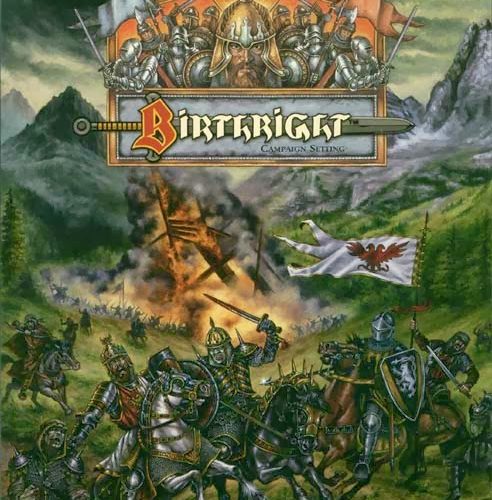
A few days ago in Bluesky, some of my favorite folks were discussing their deep affection for the 2e Birthright setting. If you’ve read this blog for any great length of time, you know that I too am a devotee of Birthright, and co-DMed a BR campaign with Kainenchen for several of our friends using Marsupialmancer’s fan update to 5e. If you’ve missed years of me talking about Birthright, here’s a quick catch-up.
Here’s the thing, though: Birthright was showing its Whiteness even by the standards of 1995, to say nothing of 2026. WotC absolutely can’t publish a setting where only one-fifth of the major regions can find even one microgram of melanin, while the other four-fifths of the known world present fantasy England, France, Ireland (the elves), Germany, Finland, Norway, Sweden, Denmark, and Russia.
The setting’s handling of other Humanoid species—goblins, orogs, and gnolls mainly—also needs a lot of rethinking to come across less racist.
This is, in short, a post about the top five large-scale changes I would make to Birthright if I were trying to publish it in the late 2020s.
One: Ethnic and Cultural Diversity
We’ll get to increasing the D&D species in a minute. Before that, I want to talk about just adding Black, Asian, Pacific Islander, and Native American ethnic representation. (And please remember that I am not actually making this, if I were creating this for real I would hire people of the relevant ethnicities to do the writing and shape the vision.) The first and easiest part is to say that the humans of Aduria weren’t lily-white, but represented a wide variety of skin tones.
But that’s nowhere near enough, because that would stop at physical representation in the art without drawing in culture. So I’d also develop at least the northern part of the continent of Aduria to present a fantasy adaptation of northern and sub-Saharan Africa. The channel between Cerilia and Aduria should be as busy with trade as the English Channel or the Strait of the Dardanelles. I’d also rearrange the map to bring the continent of Djapar closer to make it a more active part of the geopolitics of Cerilia and emphasize more Pacific Islander cultures. There’s still more work that needs to be done here, but as I mentioned before, I’m at most a participant in it.
Two: Nonhuman Species
Compared to other settings of the 90s, Birthright having multiple domains of traditionally-Evil Humanoids (goblins, orogs, gnolls, etc.) is progress, but Eberron moved that mark so far forward in 2004 that Birthright needs to catch up. The first step here is to make them available as player species and present those domains from their own perspective, where their actions are justified by their ethical framework or realpolitik.
The second step is much bigger: Birthright comes across as fundamentally xenophobic rather than cosmopolitan. The humans live in the human realms, the dwarves live in the dwarf realms, and the elves keep to themselves because they kinda hate everyone. At most I think it’s okay to note majority populations, but based purely on what we know about people, they’re going to travel and mix with one another. The provinces need to reflect this with something more than Law holdings by external powers.
The third part is to then not homogenize cultures, as has happened in Forgotten Realms. I’ve got a pretty clear idea that there’s no world where WotC spends column-inches on rich presentation of cultural detail, but they’ve got to find some way to differentiate all of these domains.
A fourth part, maybe more contentious. The idea that elves can’t be clerics because they have a grudge against the gods—that’s fine, though even in 2e the rules were explicit that you could be a Cleric of a philosophy or abstract principle and didn’t have to have a god. But the idea that Cerilian elves can’t be Druids? That comes from a super specific 2e perspective on druids, elves, and alignment that didn’t make sense in the PH, and made far less in Birthright. These elves should be all about a coldly hostile neutrality! (Though dialing that down, um, a lot… also helpful. “The last holdouts against the colonizers are the real racists and xenophobes” isn’t a great look.)
Fifth (whew), the species that players expect to be able to play has broadened wildly since 2e. There needs to be some consideration for fitting in more options without making “oh, you have horns, what the hell are you?” the beginning of every diplomatic interaction. At minimum, all of the Player’s Handbook species need to belong. If anything, carving out a meaningful space for gnomes is more complicated than doing the same for tieflings.
Three: Magic
Even though every PC might have a magical bloodline that grants them Kewl Powers, Birthright is still lower-magic than any 5e setting, because the setting emphasizes that true wizardry is set apart—there’s a separate, explicitly less powerful character class called the Magician for non-blooded sorts. Birthright also has no built-in concept of the Artificer, Barbarian, Monk, Sorcerer, or Warlock classes, to say nothing of the great majority of magical subclasses.
And frankly, I don’t think that a presentation of Birthright does the setting any favors to say that the floodgates of all content ever published will fit in here. At some point, if every option is open everywhere, there’s no difference in the player experience of one setting versus another, and (because of bloodlines and domain management) Birthright is about nothing so much as establishing a different play experience. So I know WotC wouldn’t ever go for it, for both business and design reasons, but that’s also why I can feel so confident that they’ll never try to update Birthright.
Since it’s up to me in this one blog post, though, I’d make a place for all of the classes, and make sure there were at least 3-4 subclass options that I could fit in, even if that meant I was building a bunch of new ones. Sorcerers, at least, are an uncommonly easy fit: bloodline magic is bloodline magic, and Critical Role’s Aramán setting has done incredible work centering sorcerous families.
Maybe I accept that what 2e BR meant by wizards, we now call sorcerers, and they were “wrong” about Magicians—but much like in Aramán, wizards are scrappy underdog occultists working in the shadows, cheek-by-jowl with dirtbag warlocks and weird fey or fiendish creatures to expand their grasp of magic. When people talk about the type of person who has a Source holding, most of those are sorcerers, but wizards are capable of filling that role if they ever attain such power or social standing.
Warlocks… well, Marsupialmancer did some great stuff with that, but I’d want to keep exploring the idea. I think that if you have a powerful Source holding and you have a Patron, you’re spreading your Patron’s influence in that province and along any related ley lines, making subtle changes to the land along the way.
Four: Dungeons
I did just mention that Birthright’s gameplay is different from core D&D, but I do think that it would benefit considerably from dipping a toe into dungeon-centered gameplay. There are a lot of awnsheghlien that rule domains and presumably have dangerous, exciting lairs where the PCs could track them down and fight them, possibly following espionage actions for infiltration or military actions to clear away their legions. Even the Birthright video game included extended dungeon-crawling action sequences.
I’ve already done one bit: check out this blog post tweaking Sunless Citadel for Anuire.
My target, then, would be to deepen the pre-Deismaar lore to establish former bastions of power. Let’s say Angband Lite? Now with 100% fewer Silmarils. Maybe all of them have become permanent gateways to the Shadow Realm, with the good and bad that that represents. That antiquity also makes them good places to reclaim battle magic spells and realm magic spells.
Five: Bookkeeping
The bookkeeping of domain turns can be a real bear, even with a purpose-built spreadsheet. D&D Beyond could be a huge help here. (While I’m on the topic, for the love of little green apples, get some Bastion management tools up on D&DB!) I think there are also ways to rebuild the Regency Point and Gold Bar income calculations to not involve quite so many 1d3 rolls, you know?
But don’t try to sand off the essential structure of bloodlines into using the Dragonmarked feat progression. I absolutely foresee WotC wanting to do that, but I think it’s important for PCs to want to earn and save up Regency Points to spend on improving their bloodline score to gain more powers. That’s one of the main places where good domain management feeds back into your personal-scale adventuring power. If you’re a more effective ruler and have more Regency to spare, then you get more free stuff on top of your class level progression.
Bonus: Alternate Political Structures
We’ve broadly accepted that monarchy is part of fantasy literature and gaming, and Birthright is about offering the fantasy of good governance, Game of Thrones-style power plays, and a royal court with roles for all of the PCs. That can be fun, but I would be so happy to see some alternatives crop up in Cerilia. Maybe there’s a cognate of the Most Serene Republic of Venice, where the position of regent is an elected office, and the blooded families have to contribute a point of bloodline strength as well as the power of their votes to elevate a new regent.
Or maybe there’s a governing body comparable to the Anglo-Saxon Witan, the Senate in the Roman Republic, or the Althing. (I’m sorry, my knowledge of medieval forms of government outside of Europe is atrocious.) When we ran our 5e Birthright game in Khinasi, we emphasized that the PCs needed to keep the tamounzada families of Min Dhousai happy, and that drove a lot of great political roleplay. There were also NPC generals in service to the PC regent, and the very first session was the PC regent’s investiture—followed immediately by one of the generals raising his banners in revolt.
Any limited-power structure would necessarily inform the function of Law holdings and the regent’s ability to respond to Domain Events. But that can be really interesting.
Conclusion
I know very well that Birthright isn’t making a thrilling 35th anniversary comeback in 2030 or whatever. (Alas, alack, I crumble unto dust.) I do think there’s a lot of incredible gameplay to be found in Birthright by committing to its grounded political dynamics, both mortal-to-mortal and mortal-to-awnshegh, but finding that fun means cutting away the things that don’t work with our gaming sensibilities. I’ve touched only lightly on them here. Doing them correctly is wildly outside the scope of one blog post, and like I said I don’t have the needed depth of understanding.
If you’ve enjoyed my writing, consider becoming a Patreon backer. You can support my writing for as little as $1 a month to get early access to all of this blog’s content!
You can now buy Under the Seas of Vodari in PDF!
Under the Seas of Vodari is a 300-page book that provides 5E/Fifth Edition material for both gamemasters and players to dive into a world full of action and adventure set beneath the waves of Vodari or your own campaign world. This book is a follow-up to The Seas of Vodari, a setting book filled with swashbuckling action and magical adventure. Dive into your first adventure today!