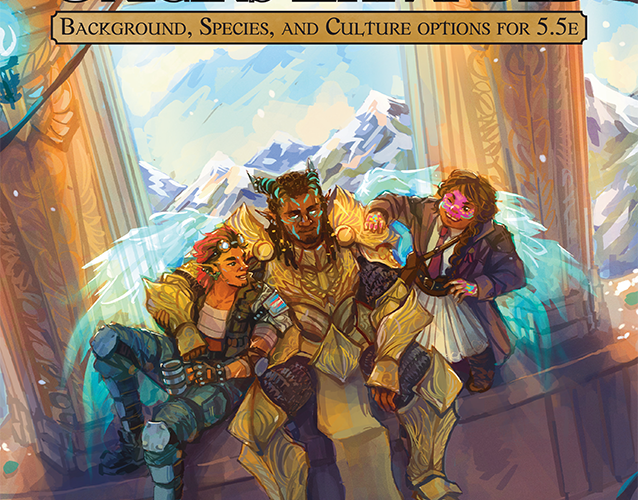
I was delighted to receive an Advanced Reader Copy of Origins Expanded: Background, Species, and Culture Options for 5.5e. Since I have this English degree, it feels great to be recognized as an advanced reader! (Oh, the life of a Gifted Kid.) It’s written by Lucas J. W. Johnson and my friend, the incredible Eugenio Vargas, with additional writing by V.M Ayala, Tanya DePass, Noordin Ali Kadir, Alex “LegalKimchi,” Derek Pounds, Tristan J. Tarwater, and Camerin Wild.
The core promise of this book is to incorporate Culture alongside Background and Species as a pillar of character-building, and to do so in a balance-neutral way. That’s not an easy task, and I’m interested in how they’ve approached it. The first three pages lay out the rationale behind this project and places where D&D and other third-party products intended to patch D&D have fallen short.
There’s one point that I want to get out of the way immediately. For many products like this one, there’s a sense that the writers think that what they’ve created is what the core rules should have been in the first place. (I don’t know if the writers of this product feel that way, and I’m definitely not asserting that they do.) But this is a 128-page supplement, 94 of which are the Backgrounds, Cultures, and Species content directly. There’s no world where a D&D Player’s Handbook could dedicate that kind of space (even with significant compacting for different layout choices) to this approach. It’s a great choice for a supplement; I don’t think WotC could have done it this way if they’d wanted to.
The product’s premise is, in a sense, infinite diversity in infinite combinations: that there are many different ways to mechanically express any given Background, Culture, and Species, or multiples of each in a single character. Two elven sages from Waterdeep (Cosmopolitan culture), for example, might have almost no traits in common: one has many Elf-based traits and a few Sage traits, while the other is deeply invested in Cosmopolitan traits with a few Elf traits. D&D doesn’t have half-elves or half-orcs anymore, and the reasons for that are good, but that doesn’t have to lead us to erasing mixed-race characters.
They approach this with a point-buy structure. Characters have a base of 12 Origin Points to spend on traits from their Background, Culture, and Species lists, and traits range from .5 to 4 points. Feats are always 3 points, and only a tiny number of traits cost 4. The traits offered in Backgrounds and Species aren’t just the existing options broken down into point values; there are new options everywhere. To cover the obvious: if your table relies heavily on D&D Beyond, it’s going to be hard to use this product, unless it becomes so popular that it’s worth a D&DB developer’s time to make it work.
I’m going to talk about some specifics here, which is only a surprise if this is the very first time you’ve ever read one of my posts.
Highlights
The 5.5e rules for Backgrounds are so stripped of story offerings and internal variety that I would like almost anything that broke out of that. The effort this text puts into broader options is very welcome.
I like the additional Backgrounds offered here: the Archaeologist and Inquisitive from Eberron: Forge of the Artificer, and the new Artist and Politician Backgrounds. The cantrips included in each Background are interesting for settings where that fits, especially Eberron and the M:tG settings.
The Sailor brings back some concept of knowledge of water vehicles with Water Vehicle Familiarity (.5 points), granting Advantage on checks to use them. I’m firmly of the opinion that cutting all forms of vehicle proficiency, rather than treating them as a kind of tool, is an error in 5.5e. Not every campaign needs that, but by far and away enough do that it’s a problem to leave it out.
Many Species can choose to be Humanoid for 0 points or another Type (such as Fiends for Tieflings) for .5 points. I greatly appreciate the sidebar that lays out the thought process here and just how advantageous a non-Humanoid type is.
I love the additional Species offered here: the Crocodilian (I have at least one friend who would never play anything but this if it’s an option), the Dryad, and the Faerie. I also like that we get Bugbears, Goblins, and Hobgoblins, and while I would personally do different things with them, I do really like what this text offers them.
The discussion of cultures and presentation of culture in fantasy games is great, especially the sidebar on The Fallacy of Monolithic Societies. For many DMs, it’s hard to get players to engage with the setting deeply enough for the complexity and nuance of this section to materialize. Maybe these options (and the desire to powergame them?) can break through for those kinds of players.
Overall, I am a huge fan of the spread of Cultures. In addition to the uses for players, these are great for inspiring setting writers to be bigger, weirder, and more exciting. I would have bought a product that was only the text of these cultures, because they’re each immensely appealing; if the creators of this product wanted to expand each of these to around five pages of suggestions and inspirations, I’d be into that.
The master trait list that is most of Appendix A is absolutely great. I even appreciate the sidebars discussing things that I don’t like as much in the text, because showing that you’ve thought about something deeply is wonderful even when I disagree in the final.
Critiques
Many of the Backgrounds and Cultures include one or more traits, priced at .5 points, that offer conditional proficiency: “You are considered to have proficiency (and sometimes Expertise) when making ability checks to [whatever].” I think this conditional approach is not a good idea for flow of play (it’s easy to forget) and forward compatibility: that is, you could reasonably wind up with non-conditional proficiency or Expertise later in the course of play, and you shouldn’t need to plan around that future contingency during this initial character creation step. Also, full Skill Proficiency is priced at 1 point, but it’s probably more than twice as valuable as the conditional option. I do tend to like conditional Advantage, as it sits comfortably alongside 5.5e’s Tool Proficiency rules.
Let’s face it, any point-buy system is going to be a powergamer playground. You can build your character to have, in essence, four Origin Feats and nothing else at all. I personally find that tedious and would be annoyed with a player that insisted on that.
The feat options of Backgrounds lean on Lucky a lot harder than I would like, at six out of twenty. It’s out of scope for this product, I understand, but if everyone gets two options, you’ve really got to expand the list of Origin feats—and they do, in Appendix C, but they also make it explicit that the new Origin Feats aren’t intended for use alongside the Origin Point system. Not that long ago, I wrote several new Origin Feats for Neon Odyssey, so I’m here to tell you that it’s hard design work! I have quibbles with the specific implementations, but I get how they landed on these mechanics as a direct result of the constraints on Origin Feat design.
The Tail Swipe option available to Crocodilians and Tieflings is one of the few traits that doesn’t do anything until you reach level 5, so you’re functionally down 3 points for levels 1-4. When it does come online, it’s incredibly overpowered—one of the only things in the book I can say this about.
The depth of cool options offered to various Cultures are by no means equal. You’ll absolutely have more options than your 12 points even come close to covering (and this is true before we take Cultures into account), but it would be nice to see Cosmopolitan, Gifting Economy, the Earth Is Our Ancestor, or Heartland of Industry get exciting, high-point-value options on par with some of the others. In essence, some cultures play subtle and some don’t, and that scans a little weirdly.
Conclusion
I think the highlights greatly outweigh my critiques with this product. This is a great book for thinking about the forces that shape your character and what you care most about expressing mechanically. It’s also great for helping DMs think about the people of their setting with more nuance and cultural richness, which can only improve our games and worlds.
You can now buy Under the Seas of Vodari in PDF!
Under the Seas of Vodari is a 300-page book that provides 5E/Fifth Edition material for both gamemasters and players to dive into a world full of action and adventure set beneath the waves of Vodari or your own campaign world. This book is a follow-up to The Seas of Vodari, a setting book filled with swashbuckling action and magical adventure. Dive into your first adventure today!